Translation's Open Secret: I Built My High School Friend an AI Translation Tool
She's a professional book translator. I automated her 'copy-paste each paragraph into ChatGPT' workflow, taught the AI her voice, had it help proofread, and made it so she can take everything and leave when she's done. Part three of the AI-in-practice series.
"Are you using AI to translate?"
That's what I asked my high school friend one day. She's a professional book translator.
"It's translation's open secret," she said. "Everyone's actually using it, but nobody talks about it."
I asked her how smoothly it went. She said the hard part wasn't whether the AI translated well — it was how annoying the process was. You paste the source text into ChatGPT one paragraph at a time, then copy each translated piece back out, hundreds of copy-pastes for a single book. Genuinely maddening.
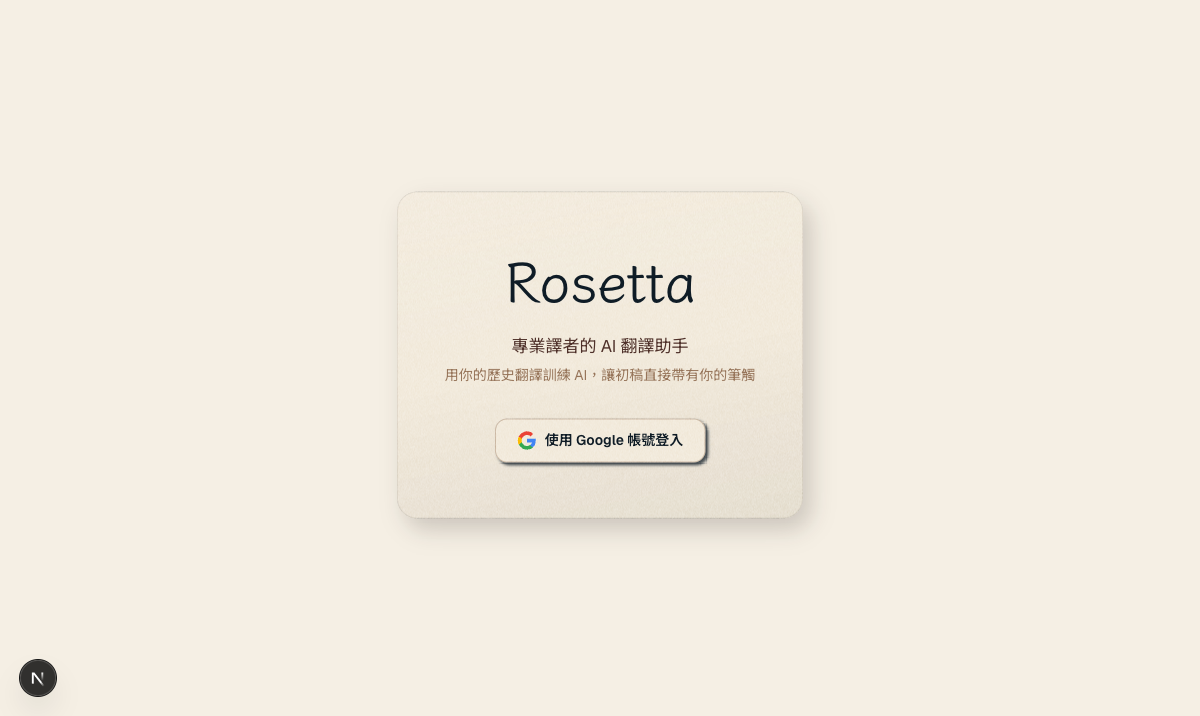
After that conversation, I built her something. It's called Rosetta.
The very first version was bare-bones: it just automated the "copy-paste" part, so she could drop a whole book in at once, have it split into segments automatically, and let the AI translate the entire thing segment by segment.
But as we built and talked, we slowly realized we could go further.
The first evolution: feed in the books she'd translated before (she gave me two to start with as references), and let the AI read them and learn how she, as a person, translates.
Things like word choices, sentence-structure habits, how warm or cool her tone runs, how she handles certain kinds of sentences. The AI gradually picks all of it up.
After that, the AI's first drafts were no longer in "AI style" — they could carry her own touch.
The second evolution: proofreading assistance. After a translation, the AI does another pass for her — comparing against the source to catch anything missed, fine-tuning the tone in her style, checking punctuation, that kind of thing.
And there's one more thing I think matters most (for a translator).
That's "take it with you when you're done."
A translator's manuscript should count as fairly sensitive commercial confidential material, possibly under a publisher's NDA too. So I designed Rosetta as a "translation workbench," not a "data warehouse."
Only the book you're currently translating sits on the site, where it gets the translation and proofreading features. Once you've finished and delivered, the translator can download the entire backup with one click, delete the project, and return to a state as if they'd never used Rosetta at all.
The tool only ever holds "the few books currently in progress."
A translator's manuscripts don't pile up on the site. The data is always the translator's own.
There's really no magical technology in any of this. It was just taking "what she does every day," sorting it out and breaking it down piece by piece — seeing what could be automated, what needed the AI, and what absolutely had to stay her own judgment.
People on social media are always asking whether AI translation will replace these professional translators.
Honestly, I also think one day it really will.
But there's bound to be a long transition period in between. The world isn't going to snatch away their livelihoods overnight, and we don't need to be that anxious. There will always be enough time for humans to slowly adapt and find new ways to collaborate.
I think Rosetta is probably positioned as a tool for that transition period.
Not to replace the translator outright, but to learn the translator's habits into the system, so the AI becomes an extension of her.
The value of a tool isn't to swap people out — it's to let skilled people keep their craft, while making it a little easier.
That said, I'm well aware a tool like Rosetta is probably a very niche market. I don't really have a sense yet of how much this SaaS could sell for, or what pricing strategy to use — but maybe I'll just put it out there and let anyone interested give it a try.
Once I'm sure it actually helps some people, and I've figured out the right pricing, I'll think about charging.
If you have some thoughts about your own professional work — you feel like you want to bring in AI but don't know where to start — come talk to me.
AI really won't replace you that quickly. First it'll take the repetitive parts off your hands, and leave the craft to you.
#Solopreneur #AIInPractice #AIAugmentsNotReplaces #ElevateYourCraft #TranslationsOpenSecret